In all our sanctuaries we sit at risk
  • Cat Vies with Hard Drive for my Soul

    Our race has re-made the world to be a reflection of our own chaotic inner lives and processes. We’ve fashioned our environment in such a way that it has become our self-portrait (if we dare to look). Perhaps we see ourselves for the first time, when we look out on the world we have made.

    And perhaps we choose, or allow into power, our leaders, in the same way. They represent some sort of answer to the questions that plague us, that disturb us in our sleep, questions we cannot resolve on our own. So we choose these individuals to resolve them for us, or as a living embodiment of the answers we think will do the job. Often, I believe, our assumptions of what sort of leader is needed, or what sort of person the leader we’ve turned to actually is, are wildly wrong. This is because we have projected onto them our own images of what we want them to be, blinded by our confusion and dissatisfaction, and yearning for relief, however illusory.

    I think Jeremy Corbin is a case in point. He still has a following, despite the dreadful election result, despite all the evidence he has provided of gross inadequacy and incapacity as Party Leader. A legend has been written, overriding the reality. The legend will rise again from the waves some day, waving Excalibur, this dream leader who never was.     

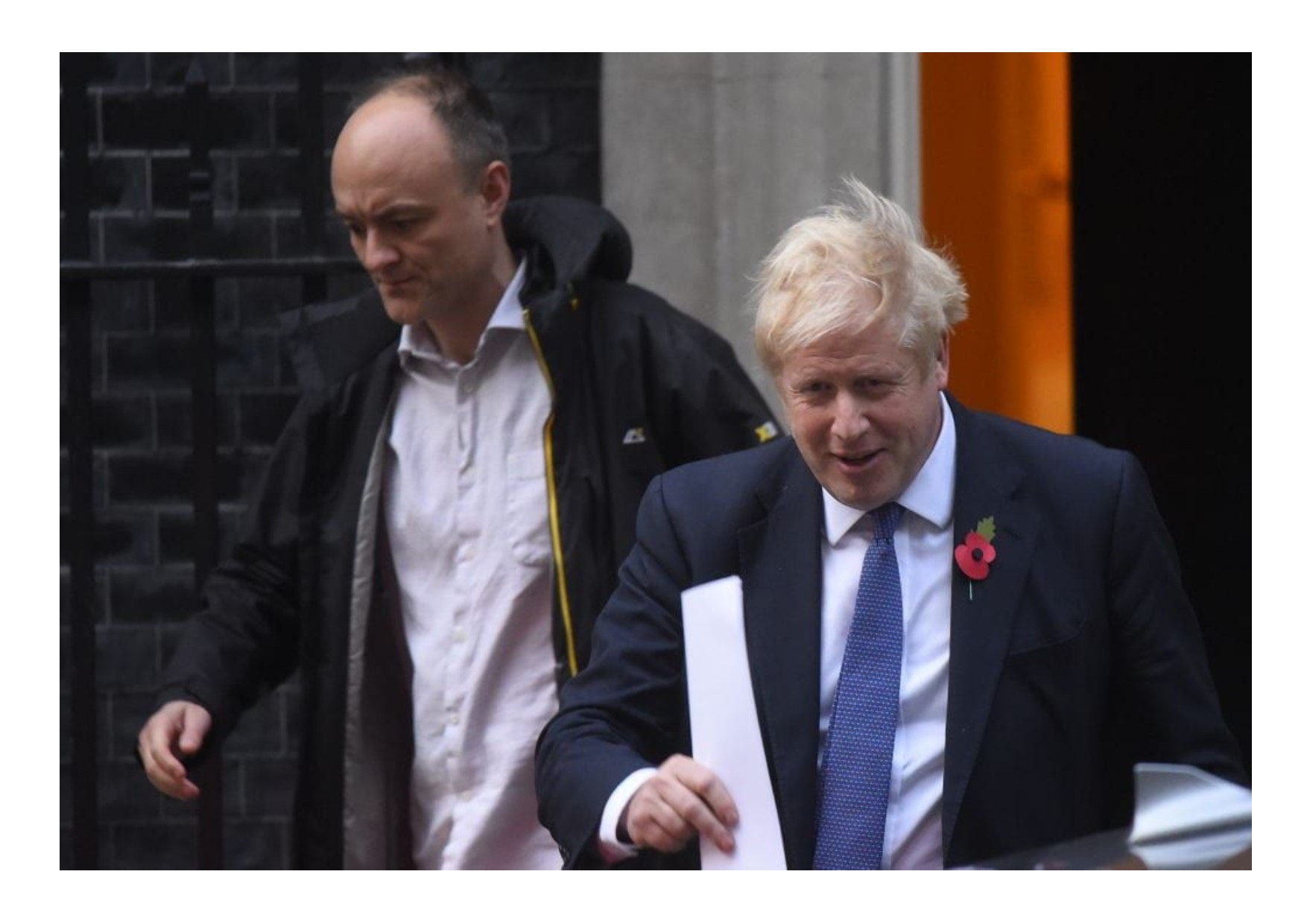
    Onto to a more present legend – in my terms, the legend of Mr Toad and Dr Doombeetle. Other people might give it a different title, such as Mr Johnson and Mr Cummings. I was recently struck by a correlation between these two individuals (whoever they really are) and the title of a book called “The Master and his Emissary – the Divided Brain and the Making of the Western World.” It is by Iain McGilchrist and was published in 2009. As I understand it, it took McGilchrist over 20 years to write. 

    And this book is not of some legend. It is a study of the human brain, a study, in other words, of how each one of us functions.  And the Master is the term McGilchrist gives to our right brain hemisphere. And the Emissary is the term he gives to our left. 

    And our two brain hemispheres are very different from one another and yet have to work in close partnership, despite the gap that exists between them, and the fact that they are not equal, nor easily complementary.

    And – wait for it – they are actually at odds. And the “emissary”, the more analytical hemisphere, which should be working in the service of the more imaginative right hand side, does not see the point or validity of the Master and strains at all times to unseat and replace it.  

    And McGilchrist suggests and demonstrates that the world we create at any one time, or in any one generation, reflects which of the human brain hemispheres is in the ascendant at that time. And if the emissary finally and fully comes out on top and takes over from the Master, the human race as a whole will not survive. For the emissary to “win,” runs against all our interests, including those of the emissary.

    Get the connection ?

    And a few years ago, I wrote a poem inspired by Iain McGilchrist’s great book, making my own kind of legend out of it. And, for the purposes of the poem, I called the left hand side of the brain “Hard Drive” and the right hand side “Cat.”

    Personally, I think things have got worse since the days of Cat and Hard Drive. Our present Toad is a dreadfully degenerate version of Cat, in thrall to Self and now hypnotised by Doombeetle’s world-view (so long as Self benefits from it).

    Truth and Reality are accordingly old hat. Now Dr Doombeetle stands at the wheel of our human ship, the human brain, while the Toad preens himself down below, in his first class cabin, admiring himself in the mirror.  

    Here is the poem :


            Cat vies with Hard Drive for my Soul


                                 A Confession of Bias


    I wish myself cat

    cats-eyes

    cats-ears


    I wish myself cat-alive

    cat alert,

    sonar centre,


    electric

    lithe advance.

    Hard-drive blunts me


    splits

    and thickens me

    Hard-drive weighs on me


    like a hump,

    an imperialist                      

    goiter.


                                       Cat asleep


    Ears at attention

    sharp as bayonets


    still scanning

    and reading.


    And eyes though closed

    are still reckoning


    keeping the captain                  

    abreast of all weathers


    as he paces

    alone


    on the bridge.

    Any time now


    those eyes will blaze

    open


    and cat will rise

    and crouch


    and bare teeth 

    and pounce.


                               Hard Drive in the bath


    Hard-drive specialises

    in mean look

    and fierce straight line.


    Curves dismay him

    They hint at softness

    and lying back in the bath.


    You don’t bathe for joy,

    proclaims Hard Drive, but for profit,

    an increase of power and standing.


    So yes, bathe often

    but with vigour

    and never lie back.


                             Hard-drive comes alive


    Hard-drive waits for nobody

    and never gives way.


    To pause is life-threatening

    and to make allowance for other life


    risks invasion                                

    by gargoyle


    possession

    by Dracula.


    I shall force my will

    on the landscape.


    I shall stamp myself on the earth

    like a brand.


    Hey mother, do you see

    this corpse at my feet


    this victim at my hands ?

    Until the moment


    of victory

    I had not arrived


    O mother, mother,

    I was not born.


                                        Cat in the Sun


    Cat glories in the sun.

    He sees it a mile off

    and knows he belongs there.


    He rolls in the hot dust

    and delights in that sliding, grain by grain,

    inwards to the skin

    to play among the follicles.


    Hard Drive can’t bear to look.

    Instead he fixes on the horizon

    in case typhoon is threatening there

    or the barbarian horse

    have broken through at last.


    Hard Drive busies himself

    on his preventive measures,

    glancing with contempt

    to where Cat lounges,

    absorbing the sun’s heat,

    cat ears pointy,

    muscles flexed.


                  Hard Drive begs to go hunting


    Gimme routine

    rages Hard Drive,

    you’re unsettling me,

    gimme something that stays

    the same, gimme repeats,

    gimme quarry to

    run down, gimme

    victims, gimme

    leave to blame.


                               Cat’s astonishment


    Cat spends all his life astonished.

    His astonishment exhausts him

    so he sleeps and then, on waking,

    is astonished all over again.


                              Interview


    So what do they make

    of each other, these two,

    Cat and Hard Drive 

    forced to travel on opposing sides

    inseparable  ?


    He leans over me

    snarls Cat, he positions

    himself way beyond his station.

    He eclipses my sun.

    He has tricked me into a cage.


    He frightens me, rages Hard Drive.

    Every pace we take along the path

    wears on me. It is like walking

    chained to a fire-storm.

    I never sleep.


                         Conclusion


     It is cat who carries the weight

    of true being,


    who loves and suffers

    in his worn flesh


    the seasons, the tides, the razed trees.


    Hard Drive lives in panic, a life-long

    franticness to avoid


    being overwhelmed. The fears

    of Hard-drive


    will overwhelm us all.


                                        Rogan Wolf, June 2013


    Posted:


  • What does “Advisor” mean in Toadland ?

    Semantics – the study of words and their meanings – is an important subject, after all. I used to hang back from it as being peripheral, academic, finickity, pedantic. But now, especially in this era when the Lie is so greatly in the ascendant, I see more clearly that being alert to how words are used, and how subtly that use can change, is a crucial way of seeing the truth of human motivation and behaviour and the use and abuse of power. 

    For words don’t just mean. They also suggest, imply, deflect, obscure, hide, deceive. Words don’t just live. They also die and kill.

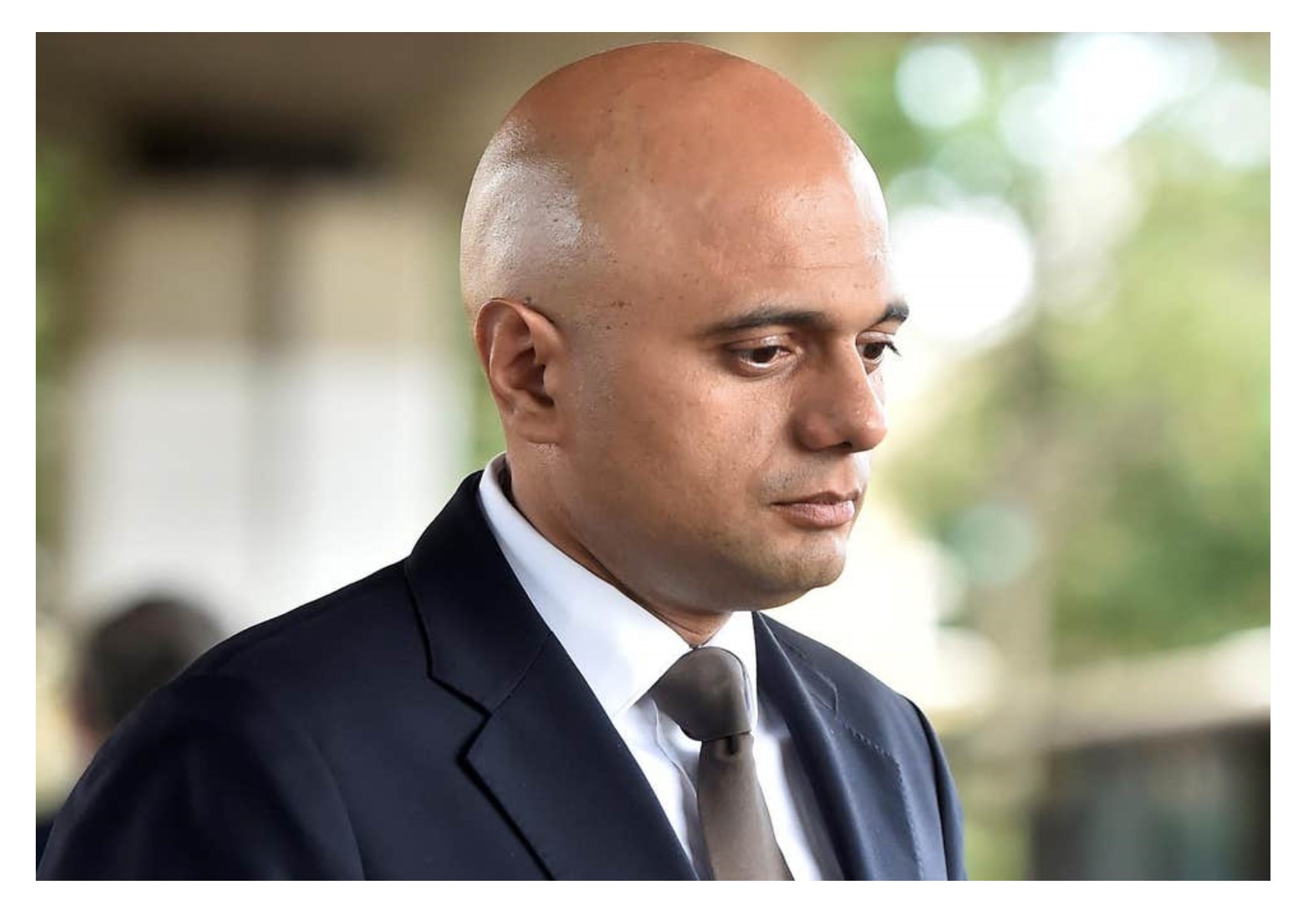
    For instance, this word “advisor.” It was being used quite a lot last week, with regard to the Toad’s reshuffling of his “cabinet” and – specifically – with Sajid Javid’s “resignation.”

    And this “resignation” was occasioned by the Toad’s insistence that, to keep his job, Javid must get rid of his Treasury “advisors” and exchange them for Number 10’s “advisors” (all of the latter answerable to Dr Doombeetle).

    But hold on. What has just been said ? Did we take note, before rushing on, or being rushed on ? Of course there’s been some discussion about Number 10’s “power-grab.” And the new cabinet’s manifest leaning towards the toadie, the rookie and the rubbery spine.

    But “advisors” ? What was really being said here ?  What is an advisor, after all, according to one’s usual or previous understanding of the term ? First, the advisor is a human being, at least in most cases, and therefore not a chattle. Second, that person might have some expertise or experience or similar set of qualities, which make him/her worth listening to. Third, you don’t have to take his/her advice. If you happen to be a Minister of State, you are the person with the power and the responsibility to make the decisions.

    But those meanings do not appear to have held good in this case, despite the word being used repeatedly.

    Here, the “advisors” appear to be toys, or furniture, or flowers, or weapons, or drones, or uniforms, ie mere objects to sweep in or out, as convenient. Not people. “Sack them ?” What for ? Incompetence, misconduct ? None of those things. Just ownership. Further, consideration of human rights, human treatment, didn’t come into it. Therefore, we must surely conclude that, at least in this case, “advisor” did not mean human being.    

    But although they’re mere objects, they seem to be regarded as very powerful and important ones. That’s why they have to be the Doombeetle’s objects and not the Chancellor’s objects.

    Maybe they’re dummies (so that, on top of Dr Doombeetle’s other extraordinary abilities, he must be a ventriloquist, as well) and that would explain why his dummies must replace those of Mr Javid. To give orders. To keep watch. Like thought-police. Like drones, hovering.

    But this is taking us a long way from what I once understood “advisor” to mean. And it is taking us a long way towards abuse of power, further debasement of quality in government, and plain abuse of people. And that already means, and in the Toad’s case has always meant, not just certain people, but any people. All people.

    Posted:


  • Where the Hoodlums Are


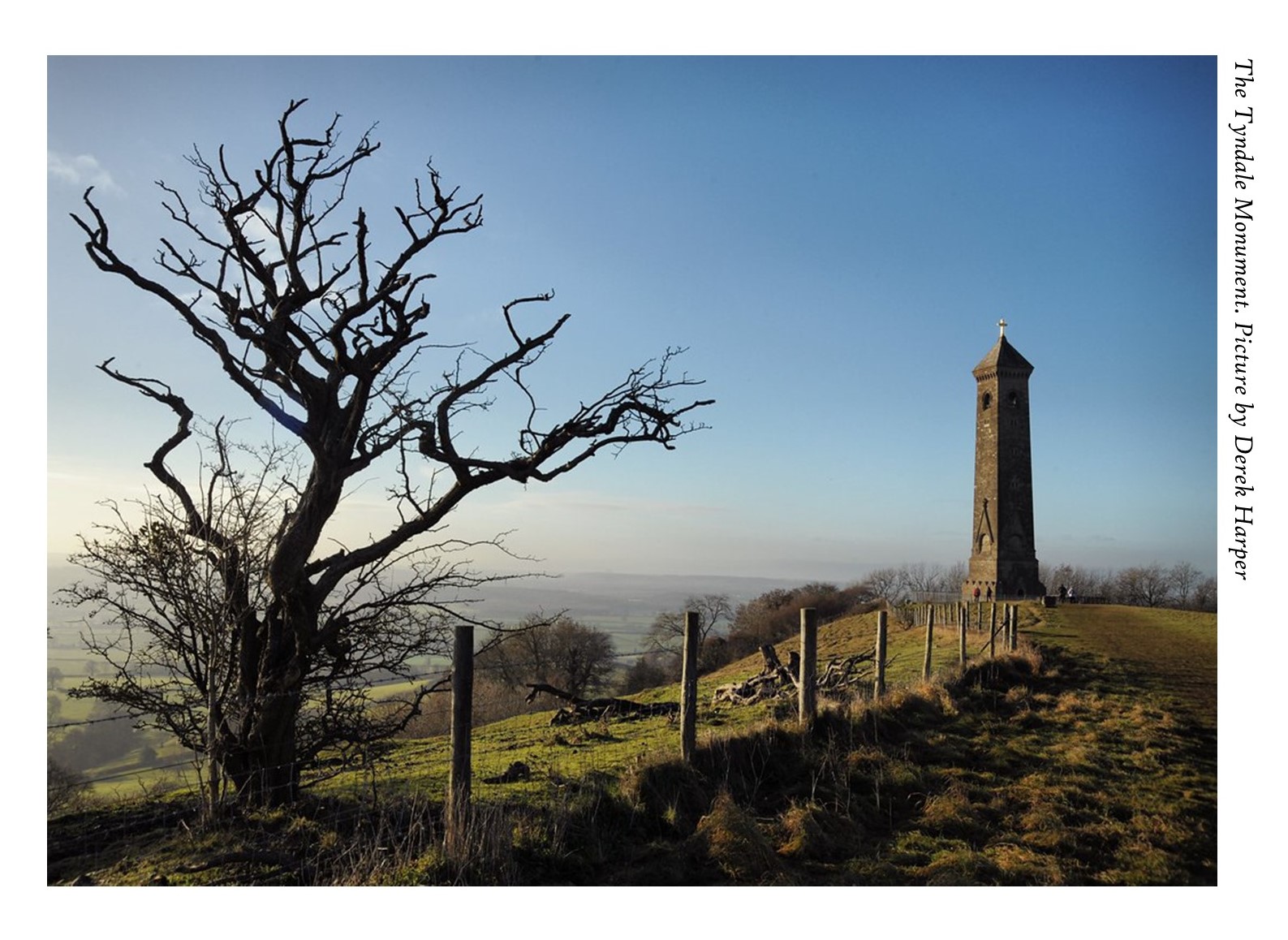
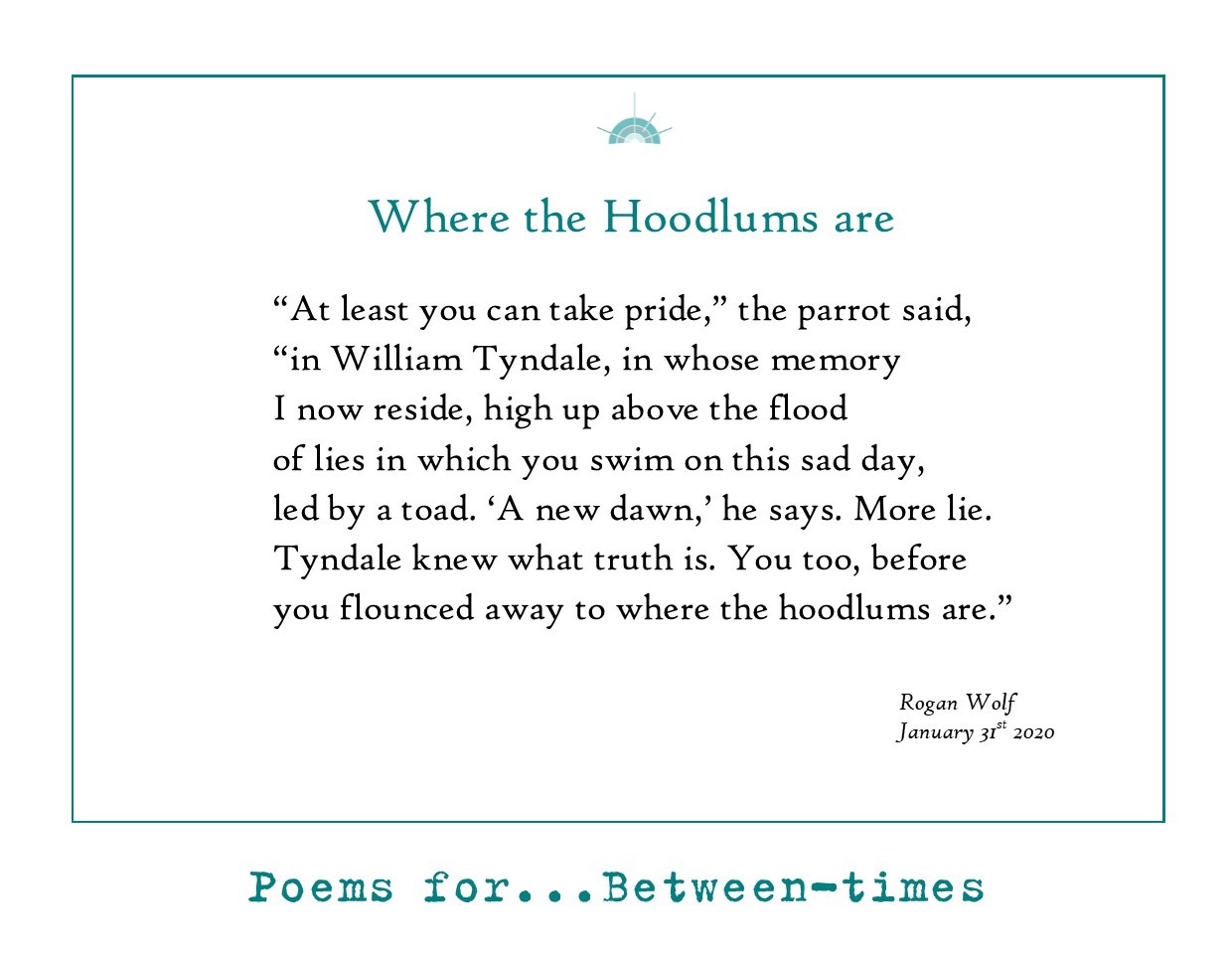
    The stanza was written and uploaded on the day the UK left the EU, January 31st, 2020. The picture is of a tower built in Victorian times in belated tribute to the great William Tyndale. It stands on the edge of  the Cotswold escarpment, overlooking the Severn estuary. The lovely photograph was taken by Derek Harper.

    “A new dawn,” is how the UK prime minister described January 31st to the nation, this man already sacked twice for lying, a man no law-abiding employer would dream of even shortlisting for a job.

    In contrast, Tyndale was interested in truth and the nation can take pride in him. The parrot has now withdrawn to the top of Tyndale’s monument and will stand sentinel there, on watch for better and wiser times when we might come to realize our mistake.

    You can climb a spiral of stone steps up to the top of the tower and nowadays might meet the parrot there, glaring at you, impatient for the flood of lies to retreat and the honour and grace of this nation be restored.

    I had thought the parrot had finished writing his verses on Brexit (see “Parrot Addenda“). There are over 150 of them, after all. But, in recognition of a tragic and shameful occasion, he couldn’t resist adding a grumpy postscript here. 


    Posted:


  • High Noon is Nearly Upon Us. Where’s the Sheriff ?

    Around the world, the hoodlums and outlaws are running amok, in their suits of armour made of lies. By contrast, the sheriffs seem downcast, overwhelmed and on the run. I feel downcast and overwhelmed, too. Might it mean that I’m a sheriff, in disguise ? But there is no star in my cupboard.

    The picture I have, or image I’m struggling with at the moment, is that, to an extent that’s hard to fathom, we – as individuals and citizens – are like onions, or trees. We are each surrounded by many layers of growth, and to a significant degree, are made of them. Those layers can fairly be called our “culture,” the medium in which we live and move.

    We can be made to feel whole and solid by these layers and we function in the world through them. They are like layers of clothing but also of skin, and go deeper in even than that and often it’s hard to differentiate between them, and harder still to tell where we begin and they end. They support, hold, interpret, orientate and place us. They provide us with familiar landmarks, aspects of the self and the world we can recognise and feel at home in and part of, memories and echoes, traditions, forms and norms of behaviour and expression, regular seasonal events, formative and instructive experiences in our pasts, etc etc.

    And, in the present bewildering times and onrush of new worlds, layer upon layer of these formative aspects of our being have been made redundant, even flayed off, made unfit for purpose, useless as signposts, or sheltering structures, leaving us feeling bereft, undefended, diminished, raw, adrift and at sea, like immigrants in a country which keeps making us strangers.

    It’s as if we’ve been equipped with keys which no longer fit too many of the world’s locks. But many of us keep thinking and acting as if they are still relevant, or still what they once were. We seem incapable of doing otherwise. Perhaps it’s not surprising.

    I wrote the original of this piece as a message to a lifelong Roman Catholic with slightly Puritan rumblings in his belly. Perhaps for that reason, I refer at this point to Christ’s struggle with the Pharisees. That struggle was resolved on the Cross and represents a permanent tension in human life – that between the true and central informing principle, the “still point” at centre, and the various forms and interpretations of that still point, the laws and modes of behaviour out here on the surface of the “turning world.”  The principle informs the law which must then be written in human letters, the pharisees’ book of rules. But what then ? In the turning world, the letter may speak at first as a fair interpretation of the principle upon which it was based. But for how long ? And in a world turning faster and faster ?

    The pharisees were aghast that Christ “worked” on the Sabbath, for instance. But that is not the true meaning, or intention, of the Law, Christ answered. Over time, you have made nonsense of the principle. You have come to worship the merely outward form, the human letter of the law. In a sense, you have come to worship merely yourselves.

    The letter remains true for only a very short while and never more briefly than in our present time. So obey the letter for its short while, but never worship it. And on the surface of our turning world, keep reviewing and refreshing it, so that it remains a true expression and application of the central principle. Too easily the letter becomes a dead letter and hence a bringer of death. Not guidance through reality, but retreat from it, a false and dangerous, voracious god.

    But in these times of unprecedented rapidity of change ? How can you keep up ? How can the letter change fast enough ? How can consciousness stay alive to so much change ? On the contrary, the temptation is to hang onto the letter, or old forms now defunct, even tighter than ever, out of sheer fear and confusion.

    And in too many cases, it is the lesser or plainly wicked people who now climb on board these hollow, failing forms, blind to their own incapacity, or seeking to profit, in some way, from the degrading of standards. In the UK, Jeremy Corbyn is an example. He has been a disastrous choice and leader of the Labour Party. His own personal refuge and comfort zone, his hollow castle on a hill, was initially mistaken for a necessary and realistic “radicalism” ; his incapacity to inspire, to manage and to lead were misinterpreted as being “authentic” and “different from the others.” Johnson, of course, is another, but he belongs more to the wicked end of the spectrum, and is doing rather well out of it. But in these circumstances, what’s “doing well” ? As things stand for all of us now, even the hooligans will suffer if hooligans “do well.”

    At the time of writing, Jeremy Corbyn is about to stand down, deluding himself to the end, claiming that – despite Labour’s grievous loss at his hands – he and his gang of bumbling back-room in-fighters “won the argument.” And we are able to study, to some extent, the people competing to replace him as party leader. And we can follow their contorted attempts to speak words, find explanations, that might carry, that might fit, that might “cut it” with the membership. Does “cut it” mean speak true ? No, it seems to mean, find some facile slogan that will soothe people and make the sloganiser more popular than his/her rivals. As popular as Jez once was ?

    And the successful candidate will be the person judged most likely to be able to save the “Party” and bring it back to power. But to what extent is Party now a dead letter, just a support system and substitute family (highly dysfunctional) for its own members, a mere familiarity without real vitality or worth or currency ? I cannot help thinking that what these people are competing for is the right to mount a dead horse. The range, the running, the references of the horse in its prime no longer exist. And it is long dead, a collection of rags and frenzied maggots.

    What can a leader say that will inspire us, while sitting on the back of a dead horse full of maggots, with forests aflame in the background ? 

    We need to begin again, in this new, climactic world. We need to work again from first principle, from the still point at centre, where the dance is. Labour is dead. Perhaps the whole concept of Party is dead. Is even the Commons dead ?

    How best to serve the truth, and make good our polity, so that we can trust it again to arrive at decisions for the truly common good, decisions properly informed ?

    It may come down, if we are lucky, to a trusted Few, trusted because they are sane and sound, leading us, the Many, afflicted and wayward as we are, out of the desert, out of the valley of our shadow. To where the dance is.

    How and where do we begin ?  Are we capable ?  

    Footnote

    Lit. Ref. “At the still point of the turning world…there the dance is” ll 16/17, Part Two, Burnt Norton, Four Quartets, by TS Eliot.

    Posted:


  • Toad and the Bong

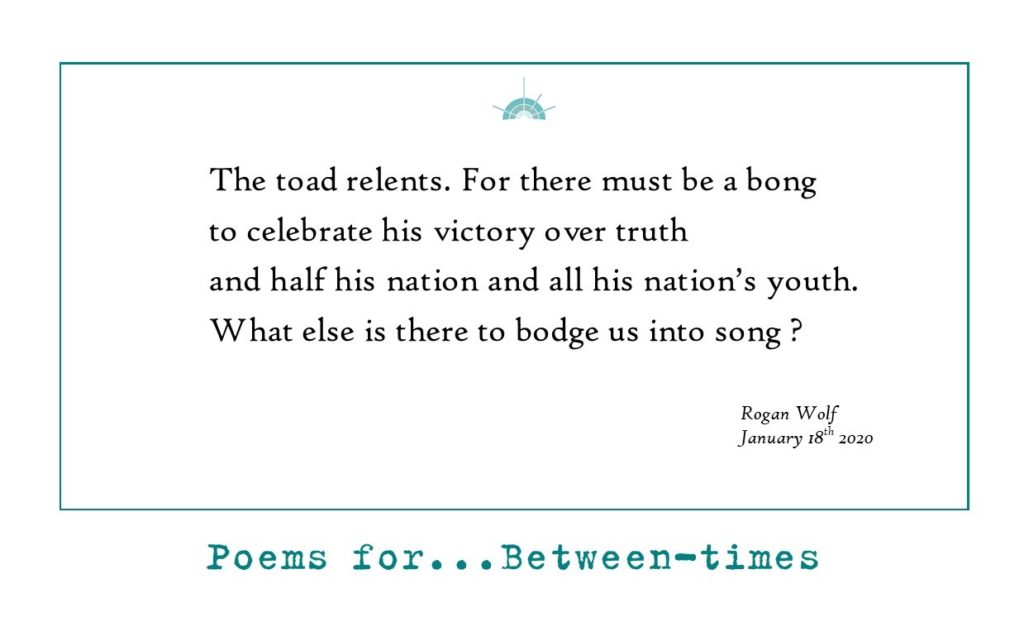
    Some of the more ardent Tory Brexiters seem very exercised that, after all, Big Ben will not be breaking into song when the UK vacates the EU and seeks alternative residence in their delinquent yet decrepit Brexit wonderland.

    And the lying Mr Toad, our bouncy new Prime Minister, is coming up with ingenious plans to soothe them.

    Footnote

    We have a literary reference here : “The Spur” is a very short (four line) poem by W.B. Yeats. Line number four runs as follows: “What else have I to spur me into song ?”

    Posted:


  • What is a Hyphen to do in 2020 ?


    There’s A and there’s B, but that’s not all. There’s also the connection between them. What is it ? They are sharing more than just the air. They were born to share more than just opposite sides of the same wall.

    A hyphen-line, a connecting scratch on the page, a fragile raft of some sort or other. Must it be a fault-line ? Or just a fleeting extra to the fatal reality of Me and Mine ?

    Or, on the contrary, is the mysterious line which connects one to another the only thing that really matters  ? And humanity’s only hope ?

    These ideas/images/questions stem from a book called “I and Thou” by Martin Buber. And the small charity I founded and run (called “Hyphen-21“) was inspired by that book, and the stand Buber takes on the centrality of the hyphen that truly connects me to Thee, me to all that’s outside of me. (The “21” belongs to our present century, of course).

    And every year, in the still period between the ending of one year and the starting of another, I have arranged for our accounts to be sent to Companies House and the Charity Commissioners ; and have written the annual report that for a while had to accompany the accounts, but now only needs to go to the charity’s Trustees as part of the accounting package.

    I enjoy the accounting, the looking back and appraising, the looking forward and exploring, the trying to make sense of, the charting of a course through.

    But what of this year ? What sense can I make of anything ? What sort of passage can a hyphen provide through a tempest, a plague, a flood ? What connections can be made to hold ?

    I decided to send out the usual report a bit more widely this time, beyond the Trustee circle. Would anyone make time to read it ? Would anyone have time enough to make some time ? And now I’ve decided to go one step further and  post it up here. It’s basically asking questions in general, rather than reporting in particular. Where have we got to ? What’s to be done ? The questions belong with all of us.

    When I began the report, the UK general election was about to take place. By the time I’d finished it, I already knew the result. Here is a link to the report.

    Posted:


  • Poems for Public Display

    I never stop yearning for good poetry to reach past its traditional catchment areas – those shelves in the bookshop marked “Poetry,” the university literature department, the dedicated arts festival, the shy, solitary and possibly eccentric brain – and find a valid place for itself in the public square, the waiting room where we all have to sit at some point and take stock, the moment of true contact in a furious crowd, in these perpetually tumultuous times.

    But do I really mean that ? Would I be content if it really happened ? If life itself became a kind of permanent arts festival ? Is that what I mean ?

    I suspect I have made an image of the whole business. I think what I really mean is that there should be more truth about the place, more emotional honesty, more honesty and goodness and fullness of word, more wholeness of being. And how could anyone disagree with that ?

    And, rightly or wrongly, I see poetry as offering those things.

    I yearn for language to cease being just a sales technique, a cloaking mechanism, a means of control, a contrivance in the service of Me and Mine and the Lie ; to cease being used as an abuse and avoidance of the Truth when we need it to be a passage to, and serving of, the Truth ; to cease being used as a tool to work on people, when it is there for us as a reaching out to our neighbours, open-handed.

    But can poetry really supply all this healing Good ? Certainly not of itself. If you put a few words together and call that a “poem,” does it automatically become some kind of benevolent or even therapeutic magic spell ?

    Of course not. But the fact is that, from time to time, I do meet words that ring in my mind and spirit, by virtue of some kind of truth I recognise in them, and/or they recognise in me, and there is some kind of music about them which seems part of their truth, as if in and through their truth, they have found a music which author and I can both dance to.

    And then there’s a funeral and it’s clear that the person who has died was sincerely loved by those who attend. For there is wordless grief running through and hanging over everyone. And a need for adequate words. And the adequate poet is called on at that point, speaking from the same love. And the poet, from that place of genuineness of feeling, offers the words that are needed and can be shared by the community, giving due honour to the departed, to the angel and mystery of death and to the grief of those who remain. And suddenly the poet and the poet’s words have become essential, ministering to the needs of the moment, everyone’s need.

    Therefore, adequate, good-enough poetry can sometimes be an answer to a simple and essential human need, and is not merely some rarified extra, or ego performance. (And surely not to be wheeled out only in times of loss ?)

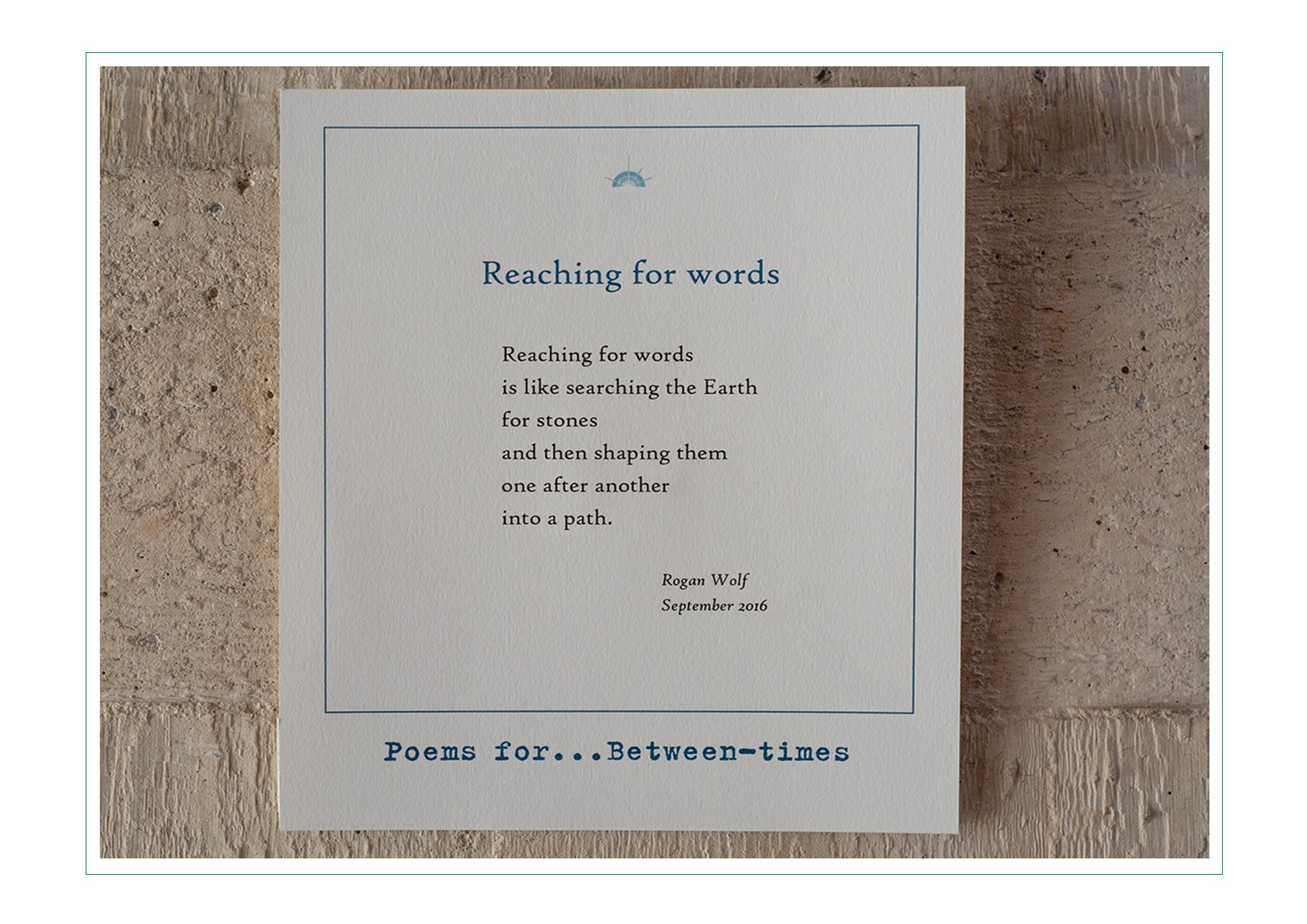
    A few months ago, I curated an exhibition of some poems from this project I run called “Poems for…the wall.”  The exhibition was held in Clifton Cathedral, a major Roman Catholic church designed and constructed in the late 1960’s and early 70’s in the architectural style of that time, sometimes called “brutalist.” I find it a remarkable building, an aid in itself to reverence and wonder, and in my opinion the poems looked lovely there.

    In fact, you might almost say that they found their true tongues there. The “brutalist” aspect of the building creates shapes and surroundings of a sort of raw essentialness. And in a way I cannot explain, the wood grain inscribed into the concrete surfaces as they dried, adds to the essentialness – a delicacy married to the massive, an organic complexity bound into the constructed simple.

    And in that setting, the poetry gave of its richness of language in a way that I don’t think I have ever experienced before. On seeing the exhibition for the first time, someone exclaimed that it was like seeing a present-day Book of Psalms open and revealed here, in a concerted cry of the nations.

    Some good photographs were taken of the exhibition, but it has taken me several months since then to find a way to project them adequately online. Now at last I have and, thanks to Google Photos, here is the link.

    Posted:


  • A New Tale of Two Cities

    This is a fable. I wrote it some time ago but it still feels apt, perhaps more than ever.

     It comes from a set of essays called “Fables and Reflections.” For the full set, see the link in the right hand margin of this page. Under the heading “Poems and Prose Online or on Film”, it’s the 11th link on the list.

    This particular fable comparing two cities features a character called Jason. Jason became more prominent as the Fables accumulated. To a degree, he  became their source, their teller.

    In his never-ending search for the golden fleece, Jason featured as a kind of between-person. He belonged in the real world, but found no footing in it, either here nor there. So where ?  He slipped between frontiers, between garden fences (like a fox), between lines.

    The fable starts, inevitably, with a famous quote from WB Yeats :

    “The best lack all conviction, while the worst /Are full of passionate intensity.”

    Jason unnamed, Jason dis-mantled, lost in his time, having no place, climbed up on a rock and spoke to an Agora long deserted. Only green lizards and goldfinches heard him. He said this:

    Let us imagine Place A.

    Place A is made of illusion. Consequently it is strongly built. The walls are thick and tall. The roads are straight and tidy. The position is high up at the top of an isolated hill and consequently easily defended with its powerful weapons of illusion. The inhabitants of Place A feel sure of their security there. It is well governed (tidy streets) and it is safe (thick walls etc.). There are few taxes to pay. There are large luxurious shops where the fancy can be fed and tickled all day long. It is a good and comfortable place to live, a firm base, a safe harbour. Its only drawback is its untruth.

    Let us imagine Place B.

    Place B is made of fact and reality. Consequently its position is disastrously exposed to attack from all directions at all times and its inhabitants are constantly rushing to defend the walls. The walls are badly built due to weak management and constant argument. The weapons at the people’s disposal are thin reeds and badly written tracts printed on recycled paper. Place B is appallingly led, with dispute, cowardice, and hesitation the predominant features of its government. Morale in Place B is so low that the hospital doctors report dramatic increases in illness both physical and mental; and the police report equally dramatic increases in crime levels. There is a constant dribble of deserters to Place A. To live in Place B is like living on a raft in heavy seas.

    Let us imagine a great crisis threatens the planet upon which both places are situated – Planet AZ. Huge fissures have begun opening up all over the surface. It transpires that the mining required to build the walls of Place A have done real and irreparable damage to the planet’s inner structures.

    Furthermore, a plague of insects has been reported streaming towards the two cities and it has been established that the insects are a new race that has bred and multiplied on the artificial fertilisers used to feed Place A’s population and the insect horde has now exhausted its local food supplies.

    Furthermore war has broken out both on the planet and in outer space and the war has been caused by the extremes of poverty experienced by peoples far away who have been grossly exploited to keep the inhabitants of Place A in the manner to which they are accustomed. Various peoples are involved, the carnage is appalling and the weapons being used (sold to them by Place A) threaten the whole planet.

    Clearly, solutions have to be found in this emergency. New answers are needed. Old patterns have to be changed. A leadership must operate which inspires the noblest possible response from the inhabitants of the two cities and is able to focus and contain that response to the maximum possible effect. For, clearly, the best human skills have to be applied, new and unprecedented levels of co-operation, the wisest possible application of knowledge, understanding, strength and organisation.

    From which city would we expect that leadership, that level of response, chiefly to come? The firm but illusory base of Place A? Or the insecure but truth-facing raft of Place B ?

    My answer has always been that the solutions needed must inevitably come from the exposed position of fact and reality. Despite the chaos there, Place B contains people whom experience has trained to live skillfully with truth and insecurity without deserting to Place A. There is nowhere to build except upon fact and there are no builders you can trust except those skilled and practiced in handling and addressing fact with familiar affection and without anxiety . Therefore, the skills and experience upon which the planet’s future depends must reside in Place B.

    Afterword

    But nowadays, said Jason, I am in doubt of my initial conclusion. For is not the exposure to reality experienced by the people of Place B so debilitating that just existing there saps all available energy ? Perhaps just keeping your balance on the raft takes up all available hope and skill. For instance, it seems that the word “intuition” which for me describes an experience of fact, is used quite easily nowadays in the world of  science, which I fear I still tend to associate with Place A. On the other hand that word can no longer be used at all in the world of social work and social care, which I still – despite everything – associate with Place B. The reason that “intuition” has become taboo in social work and similar activities is that it does not seem “scientific” enough and cannot be measured “scientifically”.

    Perhaps, after all, it is people used to the comfort, security and illusory self-belief of Place A who will come up with the answers. It will be answers already known in Place B, but not propounded or practiced effectively there, due to the habitual confusion, timidity and exhaustion that runs through the place like the very cement with which it was built.

    Small children range far from a secure home, precisely because of its security. The more secure the base, so the more adventurous you feel you can be, and the further out you feel you can go, and the more solid and settled in yourself you feel. Remember to whom Shakespeare handed the crown of the future, after the death of old Lear : not to a prince from the facile new world, the new mentalities of the Renaissance, but to Edgar, a prince from Lear’s old tired and corrupt mediaeval world, a prince now purged and scoured by Lear’s own experience of purgatory on the heath, a man still based in the old solidities but made whole from them and renewed out of them. Only the broken can become whole.

    Perhaps, after all, the teachers, the leaders, the discoveries, the changes, the solutions, will come from the false but strong and firmly established position of Place A. Initially adventurous due to its security, initially strong due to its strength, they will survive and be made whole by the scouring, the mortification, the transformation that is now required of them in order to emerge in the doorway and lead us clear of our disasters.

    A lizard ran over Jason’s foot. A goldfinch twittered, sweetly as ever.


    Posted: