I run a charity called “Hyphen-21”. The charity holds and manages funding for a project which publishes bilingual poem-posters. Since the Spring of 2017, this project has been called “Poems for …the wall” (before that it was called “Poems for…). Since it first began in 1997, “Poems for…the wall” has been funded by the UK Arts Council, the NHS, the John Lewis Partnership, the Mayor of London, the Baring Foundation and the Foreign Office, among others.
The project supplies small poem-posters for public display in healthcare waiting rooms, libraries and schools. The poems come free of charge. Many of them are bilingual, with fifty different languages represented, each with an English translation alongside.
But, in essence, the charity “Hyphen-21” is a statement of position, a sort of platform of related ideas, rather than a poetry organisation. And the charity’s position is that human connectedness is what matters most, that neither society nor humanity will survive without a sufficient modicum of connectedness between people and peoples. But connectedness means skills, not just nice feelings or states of blessedness. Call them the skills of love. “Skills of love” is a possible rendering of a phrase that can be found in a Buddhist tract called Mettā Sutta. It means the skills associated with I – Thou connection, the skills of true, warm and enabling recognition between I and Other, or others, I and reality, I and my shadow, I and my neighbour.
It would behove us to know what those skills consist of, in detail. And it would behove us to protect and tend them wherever we find them.
Here are the respective websites : www.hyphen-21.org ; www.poemsfor.org.
Incidentally, the term “I – Thou” comes from a book by Martin Buber called “I and Thou.” Apparently, Buber denied that he was either a theologian or a philosopher, but I find it impossible not to think of him as both. His book is wonderful.
The connecting hyphen between Buber’s I and Thou led to the charity’s title.
Whenever I am engaged in an initiative which seems to carry or exemplify the spirit and background principles of “Hyphen-21”, I try to attach the charity’s logo to it, if I can, sometimes quite discretely. Thus, each of the “Poems for…” posters has it in the top right corner.
And I wanted to put that logo at the head of each of the two poems I have just posted up, the poem by Robert Friend and that by David Punter. And in a recent email to Friend’s niece, Jean Cantu, I tried to explain my reasoning by sending her an essay I wrote years ago which puts together a kind of guide to action in times of crisis, by means of a diagram.
For it is that diagram that became our logo.
Jean liked the essay and found it topical and appropriate. She also found it pertinent to conditions in the Unites States, as she now experiences her country.
As it happens, I haven’t found a satisfactory way of adding the logo to the poems in this blog format (although I managed it in their respective poster versions). And I have decided to transcribe the essay here, in this separate post, uploaded at the same time as the poems. It was one of a series of fifteen essays called “Fables and Reflections” I wrote over twenty years ago. “Fables and Reflections” seem to get uncomfortably truer with each passing year. This is what the distinguished author Iain McGilchrist has to say about them : “I find it deeply touching to be asked by Rogan Wolf to write a brief forward for these clever and insightful prose poems – for that is what they are. He feels my book provides a fitting context for them. But their beauty and the imagination that created them are all his. They are full of wisdom that we need very badly to hear. I hope you enjoy them as much as I do.” Iain McGilchrist, author of “The Master and His Emissary—The Divided Brain and the Making of the Western World.”
Here below, then, is Fables and Reflections, number fourteen , called “Rome Burning”. (All the other Fables and Reflections can be found in pdf, further back in this blog) :
(Incidentally, please admire, if you can, the first diagram below. It was done free-hand, using a Victorian dip-pen. My sons gave the pen to me a few Summers ago, to commemorate my bewildered crossing over into my third age).
Rome Burning
We live in times when none of us can be sure of the ground we stand on. In effect, the ground moves too fast and in too many directions. The process can make us feel insignificant, meaningless, powerless ; and this does harm to our capacity to act.
Either we fail to act altogether, we “don’t get involved,” so switch off, disconnect, go shopping ; or we act halfheartedly, in despair, confusion, doubt, fear for ourselves ; or we hide in action behind precedent, rigidity, over-simple ideology, conformism, fanaticism. It becomes ever more difficult just to act rightly, with whole conviction, all one’s faculties free and unfearful ; and to know where and how to act with effectiveness and meaning.
In a burning Rome, why iron shirts ? In a burning Rome, what is the point of treating someone for a head-ache ? In a burning Rome, what do you do ?
The diagram below is often useful to me :
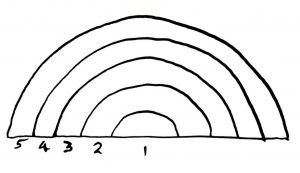
The horizontal line represents ground, the ground of our being. The surrounding arcs represent spheres of operation. Arc 1 represents the inner or most immediate sphere. It could be a person, or the core of that person. It could be your immediate family or workplace. The outer arcs, getting wider and wider, represent the different spheres of operation this unit occupies and relates to.
For example, Jane Smith carves her name on the old school desk. She writes : Jane Smith, 3 St John’s Road, Personhampton, England, Europe, the Earth, the Solar System etc. If we apply Jane’s carving to the diagram, she herself will occupy the space created by Arc 1. In Arc 2 is her house and family . In Arc 3 is the street she lives in, her immediate neighbourhood. In Arc 4 is her town. In 5 the country. In 6 the continent. And so on.
Or a community centre, where people otherwise isolated might gather. Arc 1 is the centre. Arc 2 contains its membership. Arc 3 those people’s families and communities. Arc 4 local resources, support services and institutions. Arc 5 the centre’s place in and relationship to the whole community work scene. Arc 6 that scene’s place in and relationship to the country’s welfare provision as a whole. And so on.
Or Rome.
Arc 1 contains a Roman official. Arc 2 the office where he works. Arc 3 the aspect of Roman life for which his office has responsibility. Arc 4 the whole organisation of Roman life and culture of which his office is a part. Arc 5 Roman life as it relates to other cultures, for instance there on the walls which have just been breached by barbarians carrying torches.
And so on. We can now put the questions : in which arc, or sphere of operation, does Jane Smith mostly live ? To which arc or sphere of operation does our community centre mostly belong ? Which arc or sphere of operation should hold the attention of the Roman official ? Where should they concentrate their functioning ?
My answer is that they belong equally in all spheres but in different ways. They will function in one sphere more than another, depending on circumstances and character.
I believe the diagram offers guidelines for action. I propose its use has the following implications :
Whatever your sphere of operation, your activities will neither be meaningful nor will flourish unless your centre, the innermost sphere, the core, is in good shape, is secure, focussed and operational. Literally, your centre must be solid to avoid the outer spheres collapsing on it.
Thus, you need a secure home-base, a secure centre, to go out from, and to return to, and to trust in when you are away.
Wherever you go, in body, in thought, or in action, you need to validate yourself by means of a solid centre before extending yourself beyond it.
If all goes well in the outer spheres, or if colleagues placed there are functioning adequately, then you can concentrate on work close in, without risk to creativity, integrity or meaning.
But in the following circumstances, you are obliged logically and morally to function in the outer spheres, remembering that you will function better there the more solid, meaningful and operational your inner centre, your home-base, remains :
- if your centre, your home-base, is threatened from without, in literal terms, or in terms of principle, meaning or credibility, and the appropriate organisations or people in authority are not providing adequate protection or articulation.
- if what you have or do in your inner sphere, or home-base is of special value, meaning or relevance to other spheres, and is not already in evidence there, for whatever reason.
In these circumstances, you do not need an end in view and should not presume to know one. You should merely extend your functioning outward from sphere to sphere as far as resources allow and only so far as your initiative remains meaningful, relevant and solidly based. What results, what follows, cannot be planned for and to try would be both presumptuous and unwise. All you can be sure of is that if the original position is sound, the products of that position are likely to be sound as well.
In uncharted territory, lost in turmoil, I have used this diagram of the arcs, of the spheres of operation, both as a kind of map and also as an anchorage. It is my Jane Smith. At a time when it is harder and harder to hold centre-ground, when out-dated concrete and linear thinking (in steely bright new guise) have such a powerful and all-conquering attraction, the principle and system given shape by this diagram have acted almost as a platform, a foothold in the midst of breaking ground.
I have used it too as a system of prioritisation, as a way of selecting action from action. To develop the use of the diagram to offer detailed help with prioritisation, the diagram itself needs to be changed slightly. Thus :

In this developed version, the additional lines, the “rays”, represent events, or claims upon the attention of the person or persons in the inner sphere. If the rays have a direction, it is inward, in towards arc 1, and they come to rest at different points relative to arc 1, depending on the sphere of their chief impact.
For example, if four events have just now taken place, or there are four claims for attention simultaneously pressing in on the actor(s) in sphere 1, the following simple principle can be used to help with the decision on how and in what order of priority to respond :
In normal circumstances, the more close in is the point of impact of the event , the more immediately it should be attended to. For instance, a client in crisis comes before the need to write the centre’s business plan. A fire in the office should be tackled before keeping an appointment for a business lunch.
In times of threat and crisis, however, it would be consistent to reverse this rule. If an event takes place in an outer sphere that threatens the whole operation right through to the centre, then that outer sphere requires an immediate response and all available resources from within must be co-opted to help face out.
The Roman official, for example, presented with Rome burning, would do well to forget the untidy state of his office, his anger with his boss, or his personal career ambitions ; he needs to face out ; and offer what help he can at the point at which the fire is burning.
Rogan Wolf