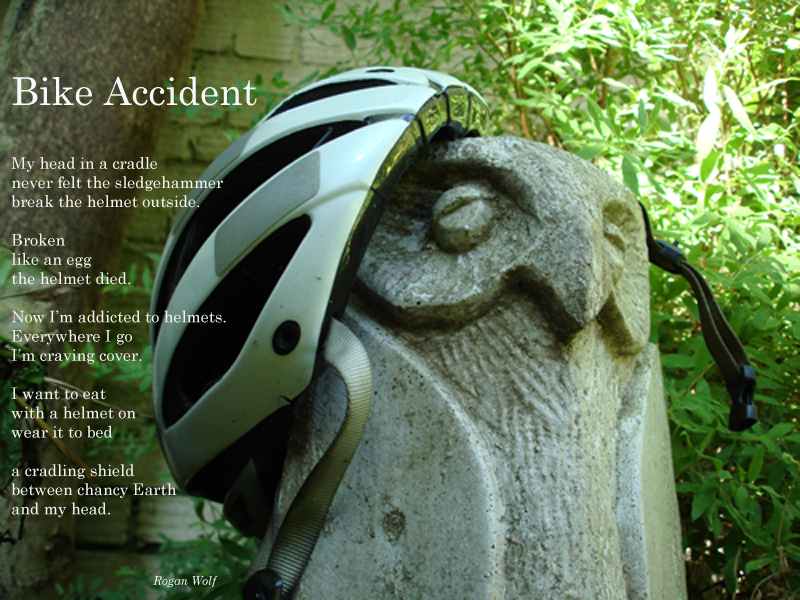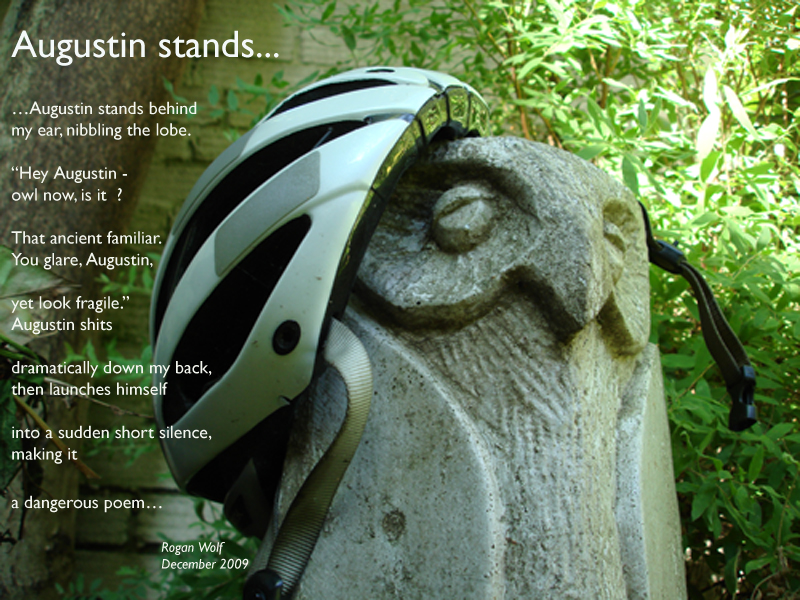
sculpture by Dorothy Love at www.dorothylove.co.uk
proposition

Last December, I ran an arts evening which needed professional actors to perform a short new play. At the audition stage, one of the candidates wrote to me as follows : “If only the theatre world was run entirely by social workers and mental health professionals ! I hope I can speak for all of us in thanking you for your concern for the actors’ feelings and convenience, something that sadly is rare in our profession.”
I have now written back to the person as follows :
“You weren’t dead serious in making that statement [about social workers] but were trying to say something about my initial approach to you all, which for me is important.
I am honestly not fishing for compliments here. What (I think) I want to do over time is articulate and identify and separate out what consititutes the sort of practice that makes things work between people, that helps people work better together, or want to perfom well, or whatever. The sort of practice that binds people in, or brings them out, in this or that common situation.
I do believe that all our futures depend on those skills flourishing and spreading. Yet they are also under great threat in these times that need them more than ever. Maybe they are even in retreat. The Market is surely one cause. Population numbers another. New forms of mass communication maybe another in some way. I’m not saying that things are worse than ever before, though. Only a slight acquaintance with History teaches you they’ve always been pretty bad.
So is there anything you can identify in the way I approached you that made you say what you said, made the difference you commented on ? As far as I was concerned I was just functioning according to learned experience, and thinking purely pragmatically down lines I assumed I needed to.
There is this phrase “The Skills of Love” which is one possible English translation of some words used in the Metta Sutra, a Buddist tract on kindness. I would claim social workers and similar care professionals are actually using the skills of love all the time (though few would dare say so). So is an experienced good parent, although the basic connection between I and Other is obviously different in the two cases. Between Parent and Child, of course, there is the blood-tie and all that personal shared history and “ownership.” Between social worker and client, there is perforce a difference of position and set of parameters, and a necessary degree of professional detachment. Nevertheless, both social worker and parent are deploying ordinary human relationship skills on the basic premise that Other is innately precious, or of value, as central in the Universe as I am, not merely an object for use.
So there is attitude as a basis, and then a huge collection of skills available for deployment, which act as the expression of that attitude. And I would say the basic attitude is not some holy state or position of virtue or goodness or piety, but merely a sober recognition of plain reality. But is it worth naming the skills, as best we can, or should we put all our attention, at this late stage in human history, into the attitude ? We’ve failed pretty conclusively on both fronts up to now.
I hope all this does not sound completely wacky.
I have been playing with these ideas for years and very very slowly coming to some decisions, however ambivalently, so your comment chimed in to a state of readiness.
Best wishes
Rogan Wolf
Posted:
But how can there be a next when we haven’t even established a starting-point ?
I suggest that to be afraid of the world ending is pointless now. There is a sense in which the world has ended already. Certainly, the solid orb our parents knew has disappeared, along with the truisms and structures they could turn to as foundation and reference point. All that remains is rush and blur, scarred light and infected wind. Anxiety, doubt. Astonishing invention. And everywhere just me, me, me, howling…
Nothing is solid. Nothing stands. Everything is over and past even before it has established itself.
So there is no footing we can take for granted. We all have to keep establishing our footfalls all the time.We have to build them. Until we’ve built something to stand upon, there is only space, and weightlessness in space, and being alone in infinite space.
In the middle of blur and franticness, in the middle of nowhere, before we can proceed to next, we have to construct a sufficient starting-point ; before leaving our starting-point to reach next, we have to make sure our starting-point will support the weight of our moving off ; before we can go forward we have to create and nurture the ground along which we may advance.
And none of that is easy. Even starting-points have more than one dimension. You create them by coming at them from unexpected angles. Starting-points are meeting-points, where lines and venturings from various lonely places come together and create some sort of fragile solidity, full of tension and possibility, a point of departure.
So don’t disturb me this Autumn. Like a spider in the mist, I’m busy. I’m threading together my point of departure, from out of nowhere.
Posted:
I believe that in its serious and commendable efforts to protect the Nation’s Health, the State is guilty of an injustice of high order as far as the mental health community is concerned. I would go further and describe this injustice as an abuse of state power, almost a case of bullying.
My complaint concerns psychiatric hospitals across the UK and the suspension this year (2009) of the right of psychiatric in-patients to smoke in their compulsory dwelling-place.
Cut to my own smoking habit. I’m an ex-smoker. In my experience, the best cigarette of the day was the first. And if I could hold on for long eough to get the coffee ready beforehand, the combination of early morning coffee with early morning cigarette was delightful. Nicotine and caffeine – both addictive of course. But for years they helped me launch myself into the day.
As I grew older, my mortality became a bit more real to me. Fear came. My smoking habit became an enemy to be fought.
Time after time I tried to give up, but always failed. The resultant self-contempt now became part of my smoker’s identity. That went on for well over a year. But finally, at a time of unusual peace and content, and on holiday, I crossed the Rubicon as if it didn’t exist. Easy. Deep breaths. No looking back.
Now let’s cut again and visit the nearest psychiatric hospital.
Unusual peace and content is not what you’ll find there. Nor will you find much free will. Nowadays, the great majority of psychiatric in-patients will be living as prisoners, held under the provisions of the Mental Health Act, having been assessed as dangerous to themselves or others. They are perhaps the least powerful people in the nation, with less rights than criminals in jail. (For instance, prisoners have a legal right to daily exercise – and prisoners over 18 are allowed to smoke in their cells).
Almost by definition, the patients we will meet here in this hospital are unlikely to understand or accept the reason for their enforced incarceration. All they will know is that the place is strange and feels frightening. Most will be in a psychotic state, ie living as if in a very nasty dream, for days and nights on end, unable to wake. In any human life there could be few lower or more vulnerable times than times spent here.
And on top of all that, the smokers among them are now being told, through their confusion, that smoking in this place is against the law. Not only must you lose your liberty, but your only comfort, too. Now. In these moments, the lowest in your life, when you are at your most fragmented, lost and bewildered, your very self, your sense and experience of who you are – deep in shadow, lost under a stone. Is this further enforced deprivation a punishment for being mad ? Is being mad still cause for fiercer punishment by Society than commiting a crime ?
Of course, Nurse can escort you outside for a smoke when Nurse is free. But very often the ward is short-staffed and Nurse is tied up for hours on end. Wait patiently. Why are you pacing up and down ? Why aren’t you joining the Art Group ? Sit down. Be good.
I support a group of service users in Westminster. Before this ruling was implemented, we worked with the local Advocacy service to write a letter to the Dept of Health outlining the problems we could predict would follow – above all the undermining of any therapeutic relationship with nursing staff, forced now to become anti-smoking security guards, policing a new boundary ; but also an increase in physical dangers, as people inevitably found ways to smoke clandestinely – in toilets and under bed-clothes.
The reply we received failed to address a single one of our arguments. It just outlined the policy about which we were complaining, as if we didn’t know it. (If only the industrious highly educated civil servants who pour out these meaningless letters knew how seriously each one weakens our democacry and disempowers us all !).
In the year or so since the ban came into effect, all our points have been borne out in practice.
What little effective argument there has been concerning this issue has taken place in the courts and has focused on the definition of what constitutes a person’s “home”. The State accepts that some people will want to smoke in their own homes and have the right to do so. By extension, a prison cell is accepted as standing in lieu of a person’s home. So private individuals and criminals can smoke where they live. But it seems that a hospital does not come under the same category, not even a long-stay hospital. So ill people cannot smoke where they live.
What’s going on here ? I can only think that the categorising mind-set, the planner’s view of the world, , the broad-brush policy-makers, make no distinction between a mental health problem and a physical illness.
In most cases of physical illness, the self, the self-will, the who-I-am and what-I-want-and-need remain intact and whole. I am here. I look around me.
In the cases of mental ill-health, the reality is often very different. I am not I, here. I am not here, here.
As far as I am concerned, to require anyone in this state of bewilderment and disconnection to give up a nicotine habit shows an arrogant insensivity and also ignorance of the human facts of the matter that is utterly astonishing. The requirement is shameful and uncivilised. People still yearn for the impossible dream – that the psychiatric hospital should really some day be a true asylum. Is this the way of getting there ? For some people this ruling has turned the hospital into a torture chamber. In the present moment, as I write this and as you read it, that torture is being experienced by people already distressed, all over the UK.
It seems to me that here is another example of policy-making in tidy boxes and along straight lines – rather than through responsiveness and care. Slogans go down easier at the end of a hard working day than complex reality can ever do. User Consultation ? Very nice idea. Good slogan. Goes down well. But listen carefully to people, as they tell you about the real harm this top-down policy is doing and distress it’s causing ? Nah. Can’t hear a word. No time. Ban smoking. Very nice idea. Goes down well.
Sometimes there is more madness on the “sane “ side of this fraught frontier that splits the world in two, a more compulsive avoidance of reality, than in any patient on a locked ward.
Rogan Wolf
Posted:
Thank you for visiting. This is my first post.
To celebrate, I shall set out three propositions which for me are seminal. The fact that all three refer to priests requires me to say that I myself am not religious. The fact is interesting, nevertheless. As a combination, the three act as a kind of base to operate from. The first is a direct quote, the other two indirect quotes, the third a poem.
Proposition One
“[Those who work alongside the vulnerable] are a group of people who are being called upon to live dangerously at many of the pressure points in our present confused, confusing and increasingly divided society. As such you are the objects of, and therefore presumably in your own persons and reflections the subjects of, a great deal of confusion, anxiety and uncertainty. Your position is highly ambivalent and ambiguous and therefore both actually painful now and potentially promising with regard to the future of our society and, indeed, of human beings on this earth.”
David Jenkins, ex-Bishop of Durham, speaking in 1988
Proposition Two
I think it was Cardinal Basil Hume who, soon after the fall of the Soviet Communist system, rebuked the triumphalism wafting from a certain magnificently coiffeured Grantham groceress – as she delighted unashamedly in the belief “we won”. The Cardinal said that it was not a matter of one system winning, the other losing. Both systems had failed to befriend and defend humanity and also to husband the environment upon which all lives depend. Both were accordingly unworthy of surviving and bound to collapse. It was just that one had collapsed a bit earlier than the other.
Proposition Three
Donald Reeves of St James’ Piccadilly
From the pulpit of St James’ Piccadilly
he harried old images back to life ;
families drove for miles from the suburbs
to place themselves in his communion.
Why blame God
for things that go wrong for us ?
he asked one Christmas.
See it the other way round –
day and night
God is hanging from wrought nails
for our sakes.
When we succeed at last
in destroying Creation
we shall relieve God of His suffering.
And Reeves called on us that Christmas –
don’t look to the main squares
the established landmarks
the rush of functionaries under the lights.
The hope of the world
wanders fugitive and fragile
in shadow
somewhere off.
Go there.
Give to it
all that is true in you.
Rogan Wolf
Posted: