Lost in the chaos of present events, we – or something in us – look to leadership for orientation, guidance and comfort. And the same something perhaps assumes that, the worse the crisis, the better that leadership must be and rescue is on the way. And assumes as well that, in this chaos, our own judgement and choice of leader – if choice we have – will be sound.
None of which follows, of course. On the contrary.
It becomes a matter of crisis management, both within and without, since the crisis is unfolding in both dimensions. What best to do ? Just keeping sane, creative and kind begins to feel like a political act of defiance, on a distressingly tiny scale. It’s not healthy nor really possible to blank out the crisis. But neither must it be allowed to overwhelm the lives of those in a position of (relatively) helpless witness.
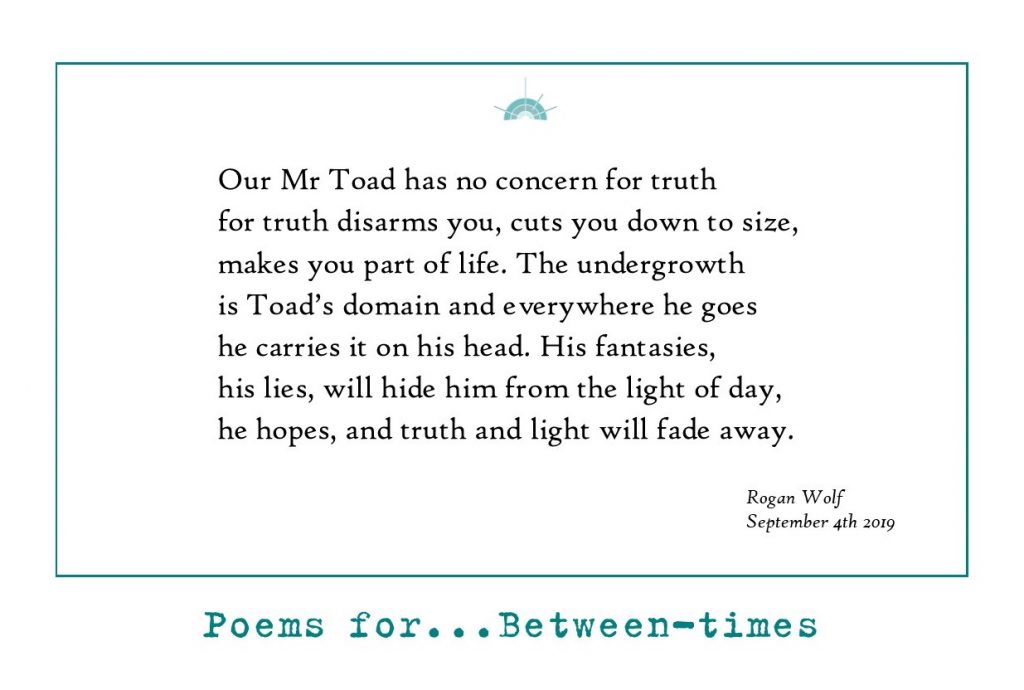
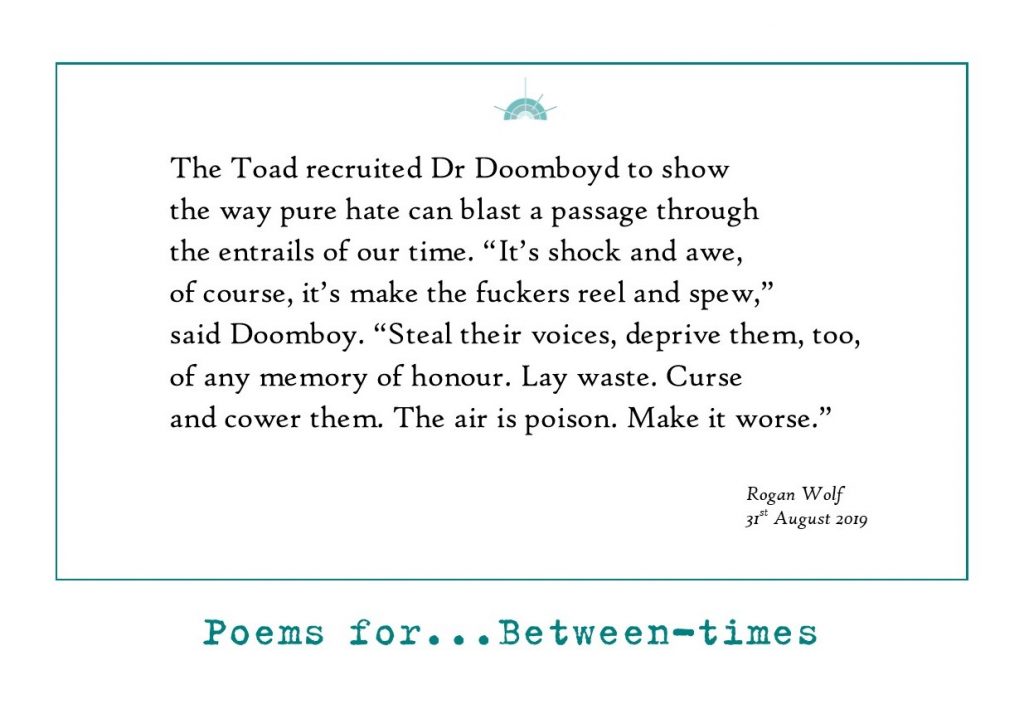
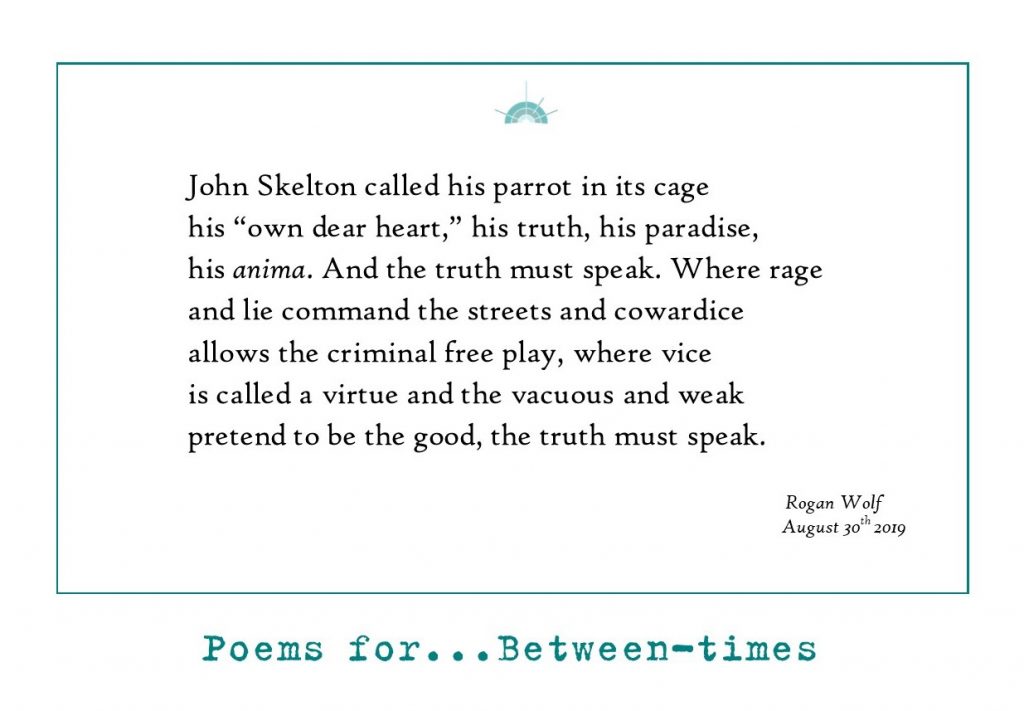
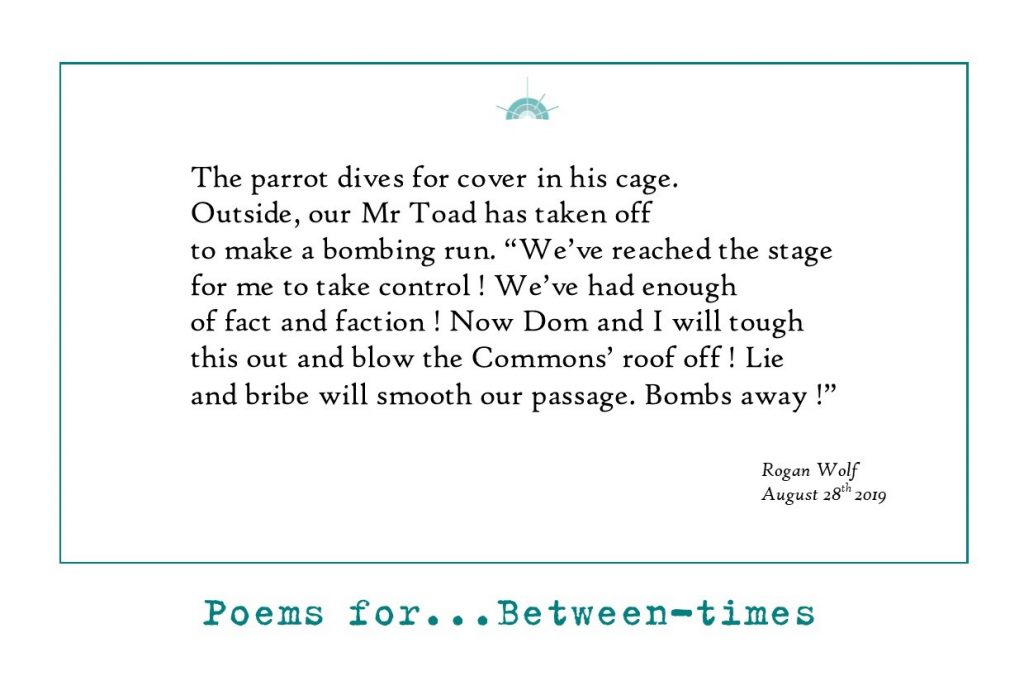
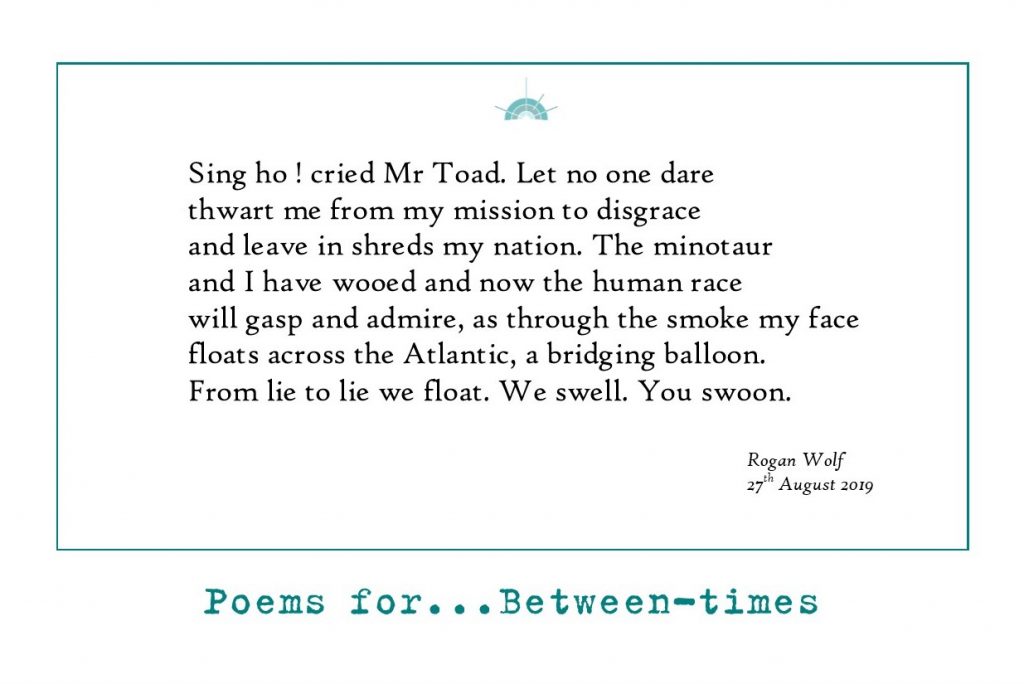
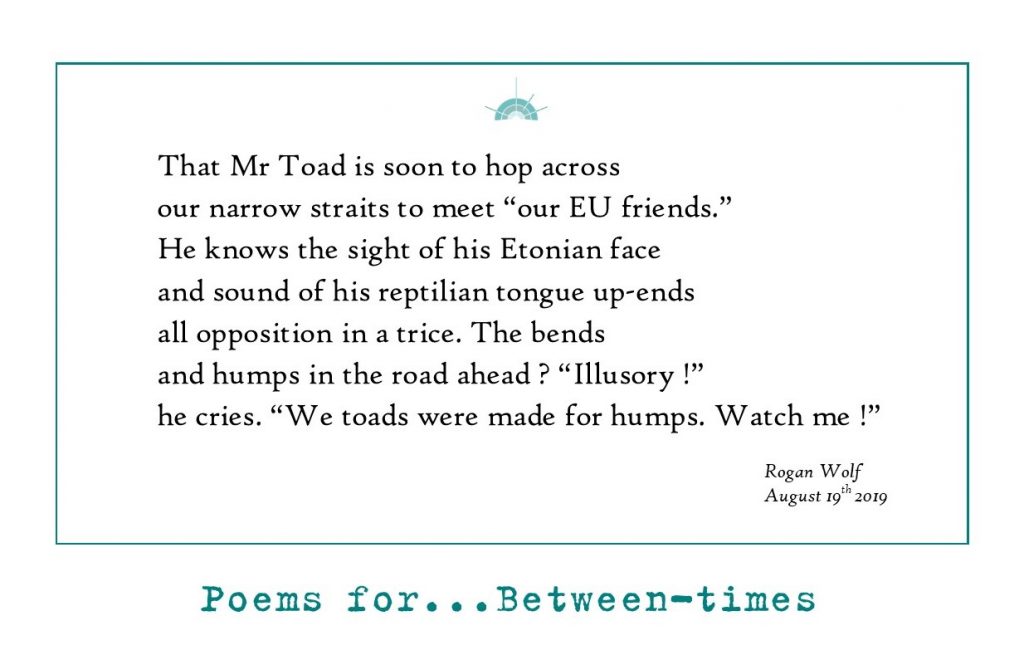
And I keep writing about the developments, putting them into traditional rhyming stanzas as if to force them into order. It feels obsessive and yet inevitable. You can’t ignore the storm, so you build these little rafts, little constructions, platforms made of words. Does it help ? In what way ? Is it doing anything at all, or only confirming the helplessness ?
Here below is another platform. This one is more ambitious than seven lines at a time and perhaps therefore even less readable. Again it’s an attempt at context, as well as satirical comment. It was first written in 2017. (See right hand margin of the home page here). I’ve just revised it to the present tense.
Dust
This is a poem about gods. It suggests that the false god Me n’ Mine has too many worshippers to be withstood. Besides Greed, the angel which serves Me n’ Mine most faithfully is the Lie and it is the Lie by which the false god rules and will destroy us all. The poem begins with the first words of St John’s gospel. It quickly interrupts that great passage, but then returns to it. From there, the poem visits the Book of Genesis, a few dot orcs and lastly, briefly, Armageddon.
In the beginning was the Word.
Conceived by light
and the power of human brain
it gave itself to human breath
and through the wondrous delicacy
of throat and tongue and lip
became sound
became meaning.
And the Word was with God
and the Word was God
and the same was in the beginning
with God.
But an instant after the Beginning,
unseen by God,
the Lie
stole into the garden
like a shadow,
the shadow of the Word,
and slid between the wonder of I
and all that’s outside of Me,
and its tongue was forked
and all a-flicker
and its eyes were cold and alert.
Nah then, the Lie whispered,
What gives ‘ere ?
And there were gods in the garden, many gods –
the true, the One, the God of Creation –
and the many that were false.
Nah then, said the Lie.
I need some living space.
To whose temple shall I offer my support
in return for my breakfast
my “daily bread” ?
And God the One, the pure truth,
Creation itself, Alpha, Omega,
the Creator of Matter, the Fact of Matter
the measureless wonder of Fact and Reality,
made no answer to the Lie’s deliberations
and merely wept.
And all along the Lie knew
its way to go and where to rest
and slid by devious means
to the gold-clad tower of a deadly
god of human sacrifice
called Me ‘n Mine.
I shall place myself
at your service, O mighty
Me ‘n Mine and help you claim
the garden for your purposes,
your jealousies and terrors
your hatreds and your pride.
I shall help you in this great work
of poison and pollution,
ruin and degradation,
in return for a daily spot of breakfast –
and let me add that more than a spot –
a “full English” you might say –
would encourage my loyalty still further
to the point
of not infrequent overtime.
They sealed their pact, recognizing
the blood-tie. And the Lie became an angel
in the service of Me ‘n Mine, a foul demi-god
with gold-lacquered wings and that familiar forked tongue,
an angelised recruiting agent
an evangelist, a soul-stealer, a maker of creatures,
creatures in thrall to Me ‘n Mine
creatures of the Lie.
And our garden once so fruitful
turns to wasteland ever more swiftly
as another one bites the dust
to the glory of Me ‘n Mine
to the glory of the Lie
and another one bites the dust…
and another one bites the dust…
So let us pause now
and study a few of these dot orcs
plucked from their robot squadrons,
these creatures of Me ‘n Mine.
Eyes right and glassily alert,
they clutch to themselves
at an angle of sameness
that spans the world
their dread weaponry of the Lie.
Of course there’s Trump.orc
Or Drumpf, or Tromb, or Dromb,
or drum or tomb or bomb.orc
dealer in dust, in money, in lies,
who favours towers which flag his name
and feudal walls of delusion and fear,
walls that divide and also confuse
fact with fantasy and truth with lie.
Where there are tired, poor and huddled masses
there we find Trump.orc,
strutting and twittering, making hay
and puerile scenes of fire and smoke.
Not America great again.
Each breath he breathes
America falls further from esteem
and becomes a fearsome joke.
But let’s turn eastward, too, to find
a lesser though quite similar joke.
Thus Maybot.orc
recently demoted
on the orders of her troops.
But when the news came through in 2016
that four dubious percentage points
would cut these islands loose
from their true place in the world
and in its history,
Maybot glowed
and made that day her own.
“The People have spoken ” she lied
in a hushed and reverential tone.
But it wasn’t the People she revered.
Maybot.orc was a pious devotee
of dust and Me n’ Mine.
“Listen to me,” she cried.
“It is I, the Maybot, who speak
and up here on high
I’m on a roll
and I shall deliver global glory
to my fraught, distraught and tiny island
and I shall have control.
“And Brexit means Brexit
and nothing has changed
and red white and blue
and stuff you, you and you.”
And the EU was not what they meant.
It was not the EU at all.
The EU was not it at all.
But then, neither was Maybot.
Our mayhem and madness
were not for her to heal.
She and her government
wandered through our wasted wheat fields,
weak and unstable
seeking support.
Failing to find it
at last she went.
Rudely to be replaced
from within her noisome train
by BoJo.orc
a Mr Toad of wind and wallow
who smirks, stumbles and fumbles
while Tories dumbly follow,
our Bullington Braveheart of the lie.
For Bojo.orc has captured the engine.
It’s Bojo and Dom now calling the shots.
And BoJo.orc makes jolly funny jokes
in Latin and loves it when we look at him
but if in some Etonian classroom
he was taught to tell the truth
he forgot that lesson ages back.
Bully bully bully, sings Bojo.orc
My lies are irresistible
and Maybot’s were so weak.
And oh those billionaire barons,
those global brothers in arms.
They devote their lives to helping each other
keep fortress walls intact
and reality at bay.
With long knives out, the barons
range the public highway
scattering gold dust, meat and wine
on any armies round the world
that march for Me n’ mine.
In the beginning was the Word
and the word was the silence of God
and a child unlooked for
asleep in the straw.
And the end when it comes
will be the triumph of the Lie
that pours like dust
from the jaws of Me’ n Mine.
We shall end in flames
in darkness and in disgrace
not with a bang
but a dust-filled whimper.
© Rogan Wolf, November 2017
Adapted August 2019